



Risk Management for PMO – Bringing Control, Clarity and Confidence to Project Delivery
There’s a point every organisation reaches where things start to feel busy but not necessarily effective.
Multiple projects are running, teams are working hard and progress is being reported. Yet deadlines slip, costs rise, outcomes fall short, and leadership struggles to maintain a clear view of what’s actually happening across the organisation.
We’ve seen this pattern time and time again.
And in many cases, what’s labelled as “transformation” is actually the result of something much more fundamental: a lack of continuous improvement over time.
Processes are allowed to become inefficient. Ways of working evolve without structure. Small operational issues are left unresolved until they eventually build into larger organisational challenges that require significant intervention to correct.
As a result, some transformation programmes aren’t truly transformational at all – they’re large-scale recovery exercises designed to fix problems that have gradually accumulated over time.
More often than not, the root cause of the issue isn’t capability. It’s a lack of structured oversight, clear prioritisation, and effective risk management at a portfolio level.

Why Risk Management Really Matters
Projects rarely fail in isolation.
They typically start with momentum, optimism, and a strong business case – yet somewhere along the line, timelines slip, costs rise, a shared resource becomes constrained, outcomes fall short, or a decision isn’t escalated in time. In fact, 78% of major project overruns are driven by cascading risks across interconnected initiatives, not single-point failures.
The financial impact is significant:
- Project delays regularly increase costs by 20–30%
- Nearly 90% of projects experience cost overruns
- Delayed delivery leads to lost revenue, extended overheads, and reputational damage
What starts as a small issue in one project can quickly become a portfolio-wide problem.
Globally, inefficiencies driven by delays cost industries an estimated £1.485 trillion annually.
This is where effective PMO risk management becomes the difference between activity and actual impact.
A PMO’s role isn’t just governance – it’s visibility, coordination, and control.
What We Often See Before a PMO Is Introduced
In one of our recent engagements, the organisation wasn’t struggling because of a lack of effort. It was struggling because work was happening in isolation, with teams operating independently rather than as a coordinated whole.
There were:
- Multiple overlapping project plans
- No single source of truth
- No clear governance or escalation path
- Inconsistent communication across stakeholders
The result?
Duplicated effort, delivery that wasn’t aligned to priorities, and a lack of confidence in decision making.
This is more common than most organisations realise.
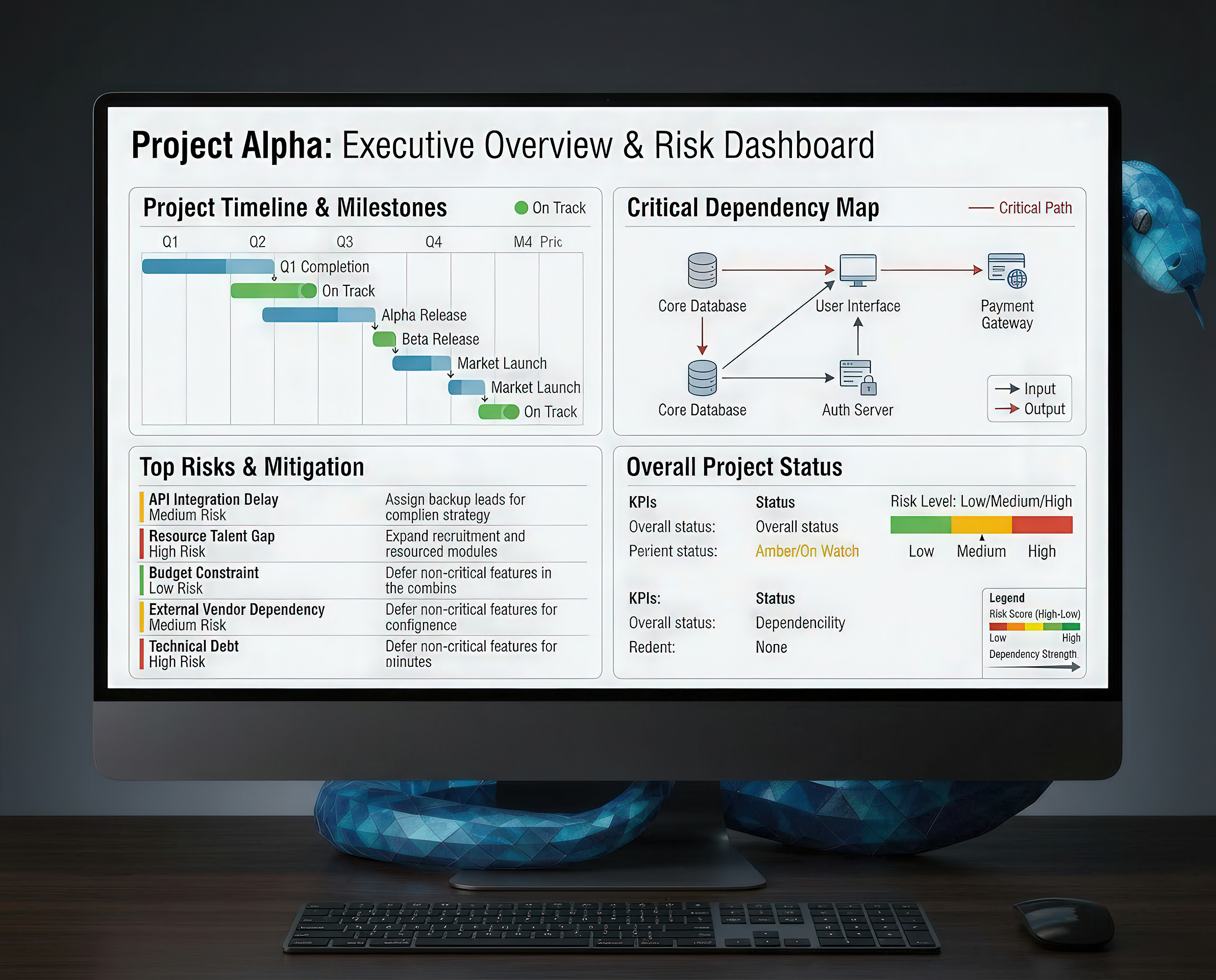
The Shift: From Fragmented Activity to Structured Delivery
The turning point comes when risk management moves from being reactive to intentional.
In that same engagement, we introduced a unified PMO approach focused on three core areas:
- Establishing a Single Governable Plan
- Instead of multiple disconnected plans, everything was aligned to one critical path – creating clarity on priorities, sequencing, and delivery timelines.
- Creating Clear Governance and Escalation Routes
- Decisions were no longer delayed or lost between teams. There was a defined structure for ownership, communication, escalation, performance visibility, and stakeholder coordination.
- Centralised Visibility
- Risks and delivery issues were visible at a portfolio level, allowing leadership teams to make faster, better-informed decisions.
The impact was immediate:
- Clearer priorities and milestones
- Stronger cross-team communication
- Faster decision making
- Greater confidence in delivery
Not because more work was done – but because the right work was understood and controlled.
Risk Management: Moving Beyond “Red, Amber, Green”
Too many organisations treat risk management as a reporting exercise.
High-performing PMOs treat it as a decision-making engine.
Across a portfolio, risks typically fall into three categories:
- Strategic: Misalignment with organisational goals
- Financial: Budget overruns and poor ROI
- Operational: Resource shortages, system failures, delivery constraints
Best Practices That Actually Work
- Standardisation of how risks are identified and scored
- Create consistent frameworks, templates, and scoring systems. Without this, risk data becomes meaningless.
- Centralised Visibility across all projects
- Use portfolio-level dashboards to monitor risks in real time. Teams using data-driven risk management are 5x more likely to make faster decisions.
- Clear Escalation Paths
- Define when and how risks are raised to leadership. Ambiguity here is where most organisations fail.
Because in reality, many risks aren’t standalone – they’re tied to wider operational and organisational challenges.

Why This Matters: The Real Cost of Getting It Wrong
Poor risk management doesn’t just cause delays – it creates measurable business damage:
- Cost overruns frequently exceed 20–30%
- Scope creep affects 47% of projects
- Changing priorities (40%), inaccurate requirements (38%), and poor communication (30%) remain key drivers of project failure
- Resource inefficiencies waste time and budget
- Delayed operations lead to lost revenue
- Reputational damage weakens stakeholder trust and future opportunities
And perhaps most importantly – organisations lose focus.
The Tools That Support It (But Don’t Replace It)
Tools help – but they don’t solve the problem on their own.
The most effective PMOs combine structure with the right enablers:
- RAID Logs (Risk, Assumptions, Issues)
- Risk Matrices (5×5)
- PPM Software such as Jira or MS Project
- Portfolio dashboards and reporting tools
But the real value comes from how these are used, not the tools themselves.
Final Thought
The most effective PMOs don’t just manage risk – they reduce the need for it.
They do this by:
- Creating clarity before execution begins
- Setting a higher bar for what enters the portfolio
- Aligning initiatives to measurable outcomes
- Ensuring leadership has visibility and control
Because ultimately, successful delivery isn’t about managing more.
It’s about managing what matters properly.
In a world where up to 90% of projects experience cost overruns, that level of control isn’t a luxury.
It’s a competitive advantage.




Sources
- Bara, M. (2025). Enhanced Monte Carlo simulation for project risk analysis: integrating cost and schedule impacts with time-shifted risks and dependency modeling. Applied Operations and Analytics, 1(1), 1–15
- Lean manufacturing, Cost of delay: the economic impact of a delay in project delivery
- International Journal of Research in Modern Engineering and Emerging Technology (IJRMEET), Impact of Construction Delays on Project Cost and Schedule
- PMI Pulse of Profession, success in disruptive times
- PMI pulse of Profession Success rates rise transforming the high cost of low performance
- Journal of technology management and business, Causes of cost overrun and solutions in construction projects in somalia
- Flyvbjerg, B., Skamris holm, M. K., & Buhl, S. L. (2003). How common and how large are cost overruns in transport infrastructure projects? Transport Reviews, 23(1), 71–88
- Factors contributing to cost overruns of construction projects
- teamstage – Project Management Statistics: Trends and Common Mistakes in 2024
- Apolloetechnical – 51 Project Management Statistics That Every Manager Should Know in 2026
- PMI the pulse of profession
- PMI, My project is failing and it’s not my fault
- PMI (2014). Requirements Management: Core Competency for Project and Program Success.
- BrenDaniel Statistics on project failure
- Microsoft, the 6 not-so-obvious reasons a project plan fails
- PMI, The blame game
Ready to take control of your projects?
Let’s have a chat. We’ll start with a no-pressure conversation to see where you might need help so we can get your team where they need to be.
Contact us today for a FREE consultation:
office@northstarprojects.co.uk
+44 1524 233 755